Average Reviews:

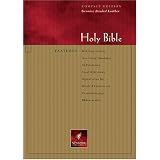
(More customer reviews)Are you looking to buy Holy Bible: New Living Translation, Navy, Compact Edition? Here is the right place to find the great deals. we can offer discounts of up to 90% on Holy Bible: New Living Translation, Navy, Compact Edition. Check out the link below:
>> Click Here to See Compare Prices and Get the Best Offers
Holy Bible: New Living Translation, Navy, Compact Edition ReviewThe much anticipated revision of the Living Bible (LB) was just recently released. The new revised Bible is being called the New Living Translation (NLT), advertised as the "publishing event of the decade." Many who have read and used the LB for personal Bible study loved its simple and easy-to-read language. However, the LB, while praised by many, both scholar and laymen alike, for its easy-to- understand prose, had to be checked against and compared with other more stricter or literal versions. The LB was noted for containing errros in certain texts. Kenneth Taylor had used the ASV to produce the highly readable LB. It is not a literal translation, based on the original Hebrew and Greek Scriptures, but a paraphrase of the Scriptures and it tended to reflect some of the views of the paraphraser and not necessarily what the original writings said.The LB has become a successful and popular Bible version, with some 40 million copies printed by 1996. In order to produce a more accurate translation, based on the original Hebrew and Greek Scriptures, a group of some 90 Bible scholars got together in 1989 to work on a revision of the LB. Their goal was to create a Bible translation that is accurate and yet reads like the LB, a paraphrase of the Bible. Did they achieve their goals? A comparison of the LB and the NLT will answer that question.
The Tetragrammaton :
One major difference between the LB and the NLT is the complete removal of the divine name from the NLT. The NLT says in its Introduction that it was decided to render the Tetragrammaton as "the LORD", following a custom that is practiced by most modern English versions of the Bible.The LB, in contrast, used the divine name, rendered as Jehovah, many times throughout the OT.The NLT, only contains the name in two footnotes in Exodus 3:16 and Exodus 6:3. The footnote reads "Hebrew Yahweh; traditionally rendered Jehovah." The name YHWH, translated in English as Yahweh or Jehovah, appears over 6,000 times in the original Hebrew Bible. However, the translators of the NLT decided to follow the custom of completely removing the Name from the Bible substituting it with the title "LORD", and confining the Name, which appeared over 6,000 times in the Hebrew text, to mere footnotes in Exodus 3:15 and Exodus 6:3.When it comes to the test of accuracy, this translation has failed by replacing YHWH (JHVH in latinized form) with a title instead of the name Yahweh or Jehovah. In that regards, the LB is more accurate than the NLT.
Interpretative Verses and Footnotes Removed: The LB has been criticized for containing interpretative verses and footnotes for selected Bible texts. For instance, the LB paraphrases Psalms 115:17 as follows: "The dead cannot sing praises to Jehovah here on earth." A footnote to the text mentions that "here on earth" is implied. However a check with more literal translations gives a different view.
The NLT gives a more accurate rendering. There it reads "The dead cannot sing praises to the LORD, for they have gone into the silence of the grave." Regarding Ecclesiastes 9:5 which reads according to the LB "For the living at least know that they will die! But the dead know nothing; they don't even have their memories." A footnote regarding that verse and verse 10 says: "These statements are Solomon's discouraged opinion, and do not reflect a knowledge of God's truth on these points!" The NLT translates Eccleciastes 9:5 as follows: "The living at least know they will die, but the dead know nothing. They have no further reward, nor are they remembered." (NLT). The revised version does not contain any footnote on that text. In Matthew 22:32, the LB reads "I am the God of Abraham, Isaac, and Jacob. So God is not the God of the dead but of the living." In a foonote Kenneth Taylor interprets that verse as if Abraham, Isaac and Moses were now alive in the presence of God. However, many hold a diffrent interpretation. Since the context is dealing with the issue of the resurrection, some hold that Jesus is emphasizing that they will certainly become alive again in the new age (compare parallel account in Luke 20:27-38 with a strict version ). The assurance that they will be alive again, explains why Jesus speaks of it as an actual event. (compare Romans 4:17).The NLT does not contain an interpretative footnote on Matthew 22:32, allowing the readers to interpret the Scriptures for themselves, and coming to a conclusion that is in harmony with the rest of the Scriptures.
Some other interpretative verses of the LB include texts such as Psalms 9:17 - "The wicked shall be sent away to hell." There the NLT reads "The wicked will go down to the grave," with a footnote stating that the Hebrew word translated grave is Sheol. The LB says in Proverbs 9:18 "But they don't realize that her former guests are now citizens of hell."; there the NLT says "But the men don't realize that heer former guests are now in the grave." The LB paraphrases the last part of 1 Peter 3:18 regarding Jesus as "though his body died, his spirit lived on." The NLT paraphrases "more literally" as: "He suffered physical death, but he was raised to life in the Spirit, " with a footnote indicating that "Spirit" can be rendered with a lower case as "spirit."
Its Language - Definately LB-LikeAs can be seen from the few samples just cited, the NLT has corrected some of the inaccuracies of the LB. It has also removed most, if not all, of the interpretative footnotes. However, it has retained the much loved easy-to-understand language of the LB.Let's read just one sample of this fast-paced, easy-to-understand version:
Isaiah 65:17-25 "Look! I am creating new heavens, and a new earth-so wonderful that no will even think about the old ones anymore. Be glad; rejoice forever in my creation! And look! I will create Jerusalem as a place of happiness. Her people will be a source of joy. I will rejoice in Jerusalem and delight in my people. And the sound of weeping and cyring will be heard no more. No longer will babies die when only a few days old. No longer will adult die before they have lived a full life. No longer will people be considered old at one hundred! Only sinners will die that young! In those days people will build houses and eat of the fruit of their own vineyards.. ...." Actually, one can just open the NLT in any page and find the Word of God beautifully expressed.
Conclusion: Its Improved in Some Respects The NLT is more reliable than the LB; it contains no interpretative footnotes like the LB; however, since NLT is still a paraphrase, some verses seem to reflect the translator(s) viewpoint (See for example Matthew 7:12 in both the LB and the NLT: both speak of the way to "hell", but in the original Greek, as noted in their footnotes, the word should read "destruction". Also, in the NLT, Romans 8:18-25, in particular verse 23, is apparently interpretative. ) The NLT, nevertheless, has fewer interpretative verses; and the translators to some extent have achieved their goal-maintaining the prose as simple as the LB and remaining as faithful as possible to the original Word of God. The major flaw, I believe, was the removal of a rendering of the Tetragrammaton as either Yahweh or Jehovah. If the name was retained it could have been a version with a very high standard of accuracy and faithfullness to the original text. Since there is no such thing as a perfect Bible version, the NLT can still be compare with other versions, especially the literal ones like the ASV or Darby's version.Holy Bible: New Living Translation, Navy, Compact Edition Overview
Want to learn more information about Holy Bible: New Living Translation, Navy, Compact Edition?
>> Click Here to See All Customer Reviews & Ratings Now

0 comments:
Post a Comment